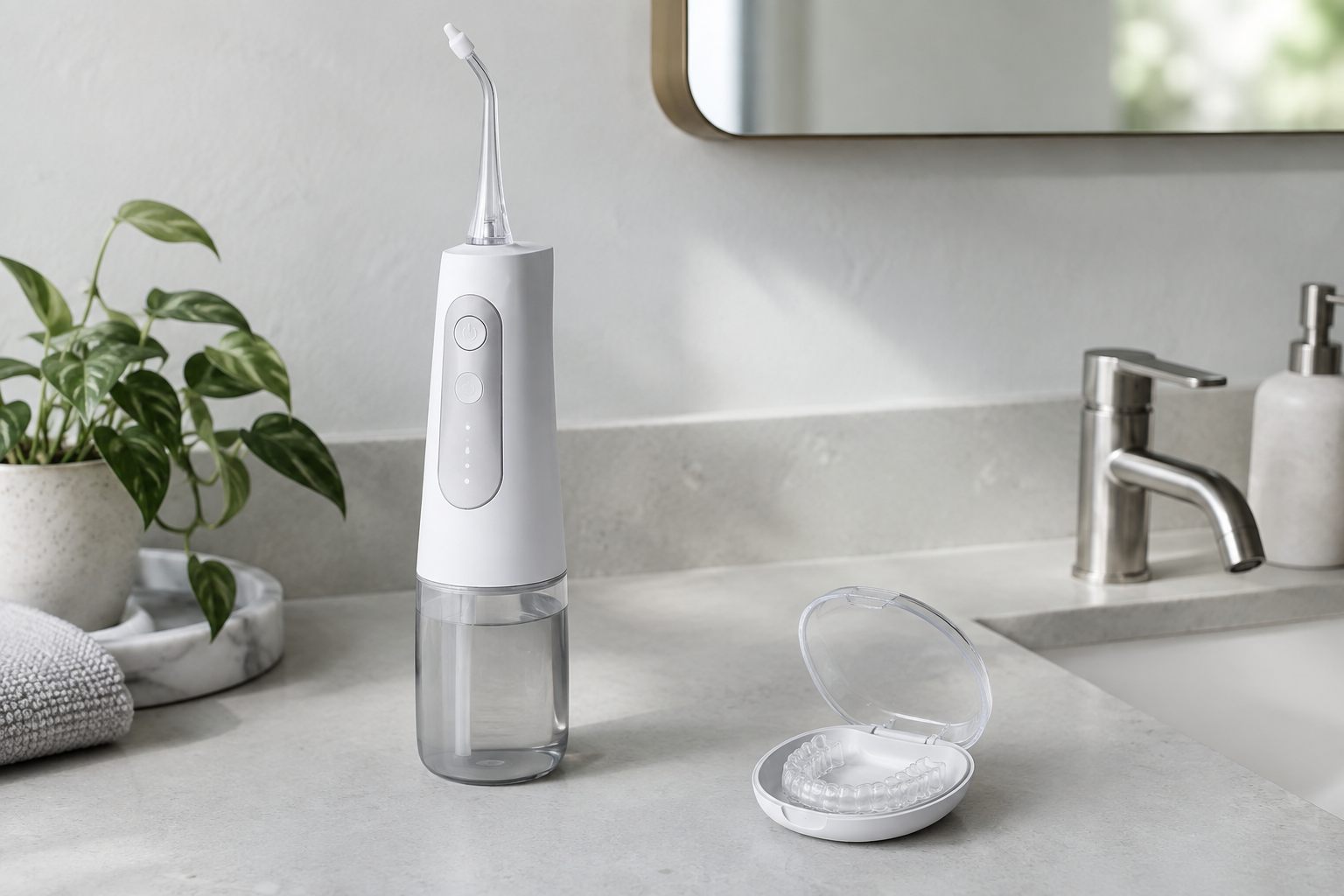
Braces, wires and bands create more places for food and plaque to collect, and they make ordinary floss awkward to thread. That is why a water flosser is often suggested for people wearing braces. It can help, but only as part of the routine your orthodontist sets, and the tip and pressure matter more than the brand.
This guide explains what a water flosser can and cannot do around braces, what to look for, how it compares with the other tools, and how to avoid the mistakes that cause bleeding gums or wasted money.
Why braces make cleaning harder
Braces add brackets, archwires, ligatures or bands to the teeth. Each of these creates edges and gaps where plaque and food can sit: around the base of a bracket, under the wire, and along the gumline. Some of those areas are hard to reach with a normal brush, and threading string floss under a wire takes time and patience.
Plaque that stays against the gums can cause inflammation and bleeding, which is why the aim is to disrupt it gently and often, not to scrub harder.
What a water flosser can and cannot do
A water flosser sends a thin, pulsed stream of water along the gumline and around the appliance. It can rinse loose debris from around brackets and under wires, and it can help along the gumline where a brush struggles. For many people it makes an awkward routine quicker.
What it cannot do is scrape the flat sides of the teeth where they touch. That is the job of floss, an interdental brush or a floss threader. A water flosser also does not replace brushing, or remove the need for regular professional care.
The practical picture is a routine, not a single device:
- Brush thoroughly, as your orthodontist advises.
- Use an interdental brush or floss threader where you can reach between the teeth and under the wire.
- Use the water flosser to rinse around the brackets and along the gumline.
- Keep your check-ups.
What to look for before buying
Three details decide whether a water flosser is useful with braces:
- An orthodontic tip. Orthodontic tips are shaped to direct the stream around brackets and wires. Check that the exact model lists one, and note the part number so you can reorder.
- A real low setting. Braces can leave the gums tender, so a gentle, clearly described low-pressure setting matters more than a high maximum. Devices with stepless or multi-level controls make this easier to manage.
- Practical tank and charging. You will use it at least once a day, so check how the reservoir fills and drains, how long it runs per fill, and how it charges. A tool you can keep clean and charged is more likely to be used.
If you travel, a cordless model with a travel lock and tip storage is easier to pack than a countertop unit. Our travel water-flosser checklist covers that decision.
How to use it around braces
The exact technique is something to confirm with your orthodontist, since it depends on your appliance. Our step-by-step water flosser guide covers the basic routine. Around braces, the general shape of it is gentle and unhurried:
- Start on the lowest setting and let the water do the work rather than pressing the tip against the teeth.
- Guide the stream along the gumline and around the outside and inside of each bracket, taking your time.
- Keep the tip clear of your gums if it feels sharp or uncomfortable, and stop at any pain or bleeding that does not settle.
- Clean and dry the device and never share the tip. Our cleaning guide covers the routine.
Bleeding gums are a signal, not a target. If your gums bleed regularly when you clean around braces, tell your orthodontist or dentist rather than increasing the pressure.
Water flosser vs interdental brush vs floss
These tools do different jobs, so comparing them as rivals misses the point.
- Water flosser: rinses around brackets, wires and the gumline; good for debris and for people who find floss difficult.
- Interdental brush: a small brush that scrubs between teeth and around the base of brackets where the space allows. Our interdental brush guide covers sizing and technique.
- Floss threader or superfloss: gets string floss under the wire and against the sides of the teeth.
A common braces routine uses brushing plus one of the inter-thread tools plus a water flosser. What you use, and how often, is worth confirming with your orthodontist.
Mistakes to avoid
- Turning the pressure up to try to dislodge something. More force does not clean better and can injure the gums.
- Sharing tips, or leaving the device to grow stagnant water in a warm bathroom.
- Skipping the areas an interdental brush reaches because the flosser feels quicker.
- Ignoring persistent bleeding, swelling or pain, which need a professional, not a stronger setting.
A store example, clearly labeled
If you are choosing a cordless model for a braces routine, the Cordless Water Flosser from Oral Cove is a real listing in our owner’s store, where it is described with three pressure settings, a 200 ml reservoir and USB-C charging. Confirm that the low setting is genuinely gentle and that a compatible orthodontic tip is available before buying. We have not tested it, and FlosserGuide and Oral Cove share an owner.
Sources and limits
- American Dental Association, MouthHealthy: braces — general guidance on caring for teeth with braces.
- American Dental Association, MouthHealthy: flossing — cleaning between the teeth.
This is practical hygiene information, not clinical advice for your appliance. Follow your orthodontist’s instructions and ask them which tip, pressure and technique are right for you.
Common questions
Is a water flosser good for braces?
A water flosser can help clean around brackets, wires and bands where a toothbrush struggles, and many orthodontists suggest one as an addition to brushing. It is not a replacement for brushing, for cleaning between the teeth where you can, or for the specific instructions your orthodontist gives you for your appliance.
What tip should I use for braces?
Look for an orthodontic tip designed to reach around brackets and wires, with a part number you can reorder. A standard tip can work for general rinsing, but an orthodontic tip is shaped to direct the stream around the appliance. Confirm compatibility with the exact model before buying.
What pressure setting is safe with braces?
Start on the lowest setting the device offers and stay there until you are comfortable and your orthodontist agrees. Braces can make the gums more sensitive, and a high maximum pressure is not the goal. If a device has no clear low setting, or you feel you need more force, ask a professional rather than turning it up.
Can a water flosser replace flossing with braces?
Usually no. A water flosser cleans and rinses around the appliance, but it does not scrape the sides of the teeth the way floss or an interdental brush does. Most routines combine brushing, a water flosser, and an interdental brush or floss threader. Ask your orthodontist what is appropriate for your braces.
Found a source that changes the advice? Send the article URL and supporting information to hello@flosserguide.com. We welcome corrections.